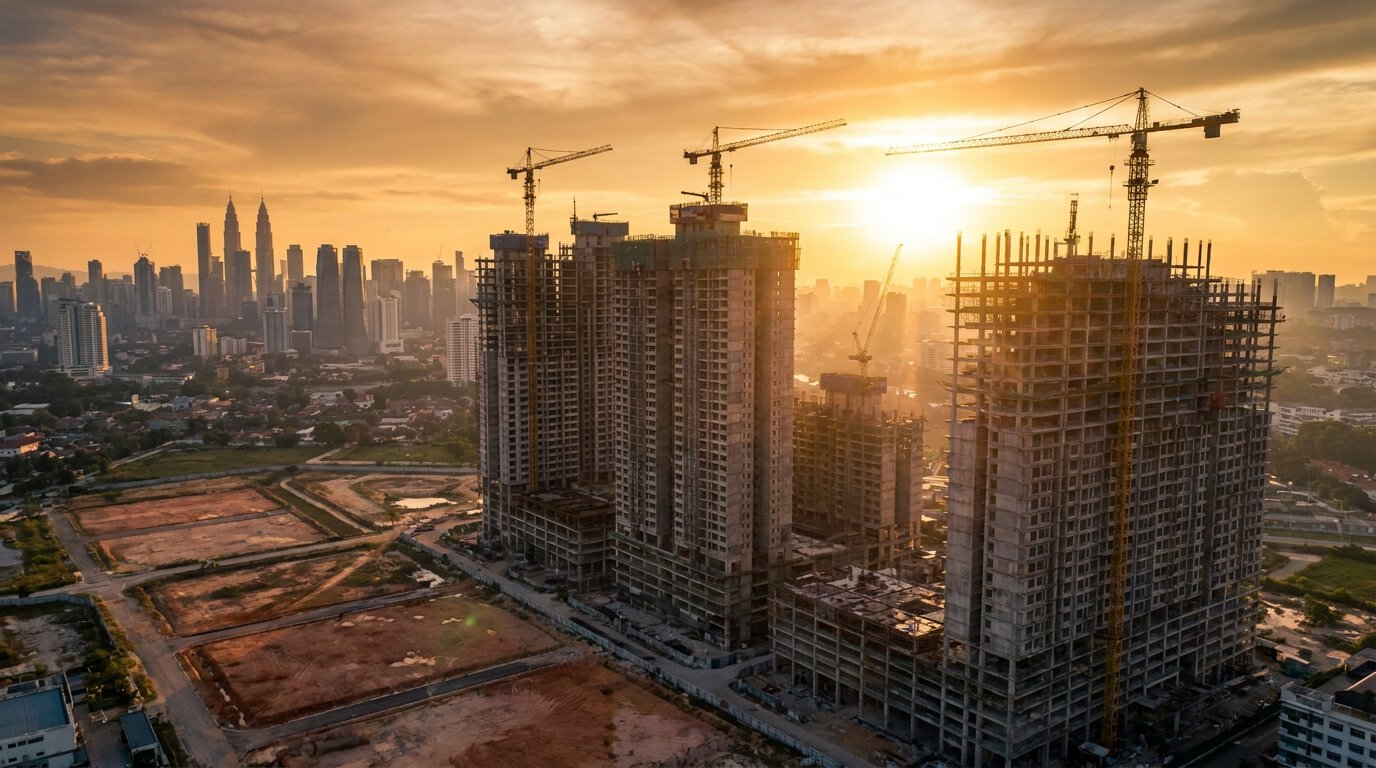
TL;DR: Three major land deals this week — YNH Property, UEM Sunrise, and Mah Sing — represent close to RM7.9 billion in combined future GDV. Despite market caution elsewhere, developers are still deploying serious capital into new launches. But they're doing it differently: capital-light structures, joint collaborations, and risk-managed partnerships instead of going it alone. The same discipline needs to show up in how developers sell. Demand hasn't disappeared. The old way of chasing it has stopped working.
Is the Malaysian property market actually slowing down in 2026?
Not based on what developers are doing with their balance sheets. In the space of a single week, three separate deals were announced that together commit close to RM7.9 billion in gross development value to new projects:
- <strong>YNH Property</strong> disposed of 2.61 acres in KL to Chin Hin Group Property for RM455 million, clearing the way for a mixed-use redevelopment with an estimated RM3.6 billion GDV.
- <strong>UEM Sunrise</strong> signed a Development Rights Arrangement (DRA) with Exsim KLCC on its 1.6-acre Jalan Ampang land, guaranteeing RM415 million plus profit-sharing upside on a project analysts estimate could reach close to RM2 billion GDV.
- <strong>Mah Sing</strong> proposed acquiring 419 acres in Kulai, Johor for RM273.87 million, anchoring a RM2.26 billion industrial park tied to the Johor–Singapore Special Economic Zone.
If the market were genuinely cooling, this isn't what capital deployment would look like. Confidence in future demand is still there.
Why are developers using joint ventures instead of developing land alone?
Because it limits capital exposure and execution risk while still capturing the upside. Not one of these three developers is taking on a project entirely alone, entirely in cash, or entirely at their own risk.
UEM Sunrise said it directly: the DRA structure lets them monetise a prime asset "while avoiding the substantial capital commitment and execution risks associated with undertaking the project itself." They'd rather preserve balance sheet flexibility for higher-priority projects already in the pipeline than sink everything into one site.
Mah Sing isn't building the Kulai industrial park solo either — it's structured around a collaboration with KLK Land, built specifically to attract investment into the JS-SEZ corridor.
YNH exited its KL land entirely, handing the RM3.6 billion redevelopment to a buyer better positioned to execute it.
Three different deals, one shared instinct: deploy capital, but don't deploy it recklessly. Structure the risk. Move deliberately.
What does "smart, not reckless" have to do with sales?
Everything. Here's the disconnect most developers don't see: the same organisation that structures a DRA to protect its balance sheet will often still run its sales funnel exactly the way it did five years ago.
Generic contact forms. Leads sitting in a shared inbox. WhatsApp enquiries answered whenever someone gets around to it. One sales team juggling enquiries across three or four live projects with no system telling them who to call first.
That's the capital-reckless version of selling — throwing effort at the funnel and hoping the right leads surface in time. And it's costing developers real buyers.
How fast should a sales team respond to a property lead?
Within five minutes, ideally. Research from MIT's Lead Response Management study found that responding to a lead within five minutes makes you up to 100 times more likely to make contact than waiting even thirty minutes. Malaysian buyers browsing multiple launches at once won't wait around for a callback.
If developers are willing to restructure how they deploy capital to protect against risk, the same logic should apply to how they capture demand. Confidence in the market doesn't mean anything if the leads it generates go cold before your team reaches them.
What's the best CRM for property developers managing multiple launches in Malaysia?
One built specifically for how developers sell, not a generic sales CRM retrofitted for property. It doesn't require rebuilding your sales operation from scratch — it requires the same principle as the land deals above: structure, not extra effort.
A few things this looks like in practice:
- <strong>Automatic lead routing</strong> instead of manual assignment, so enquiries reach the right salesperson in seconds, not hours.
- <strong>One unified system across every live project</strong>, so your team isn't switching between spreadsheets and group chats depending on which launch a lead came from.
- <strong>A single source of truth for follow-up</strong>, so no lead falls through the cracks between first contact and booking.
This is precisely the gap SalesCandy and MHub CRM are built to close — automatically routing new enquiries to the right salesperson within 25 seconds of capture, across every channel a buyer might come in from, and keeping the full follow-through inside one connected system rather than scattered across tools. It's the sales-side equivalent of the capital discipline these developers are already showing on the land side.