How progress billing works in
Malaysian property development
Every Third Schedule stage, what triggers a billing, who you bill, and when payment is actually due. A working reference for developer credit administration teams.
- August 2026
- last reviewed
- 9 min
- read
- Free
- no login, no email
The short answer
A developer bills the purchaser in stages tied to construction milestones set out in the Third Schedule of the statutory Sale and Purchase Agreement. Each stage has a fixed percentage. A billing can only be raised once the developer's architect or engineer certifies that the stage is complete, and payment falls due 30 days after the purchaser receives that notice.
That is the whole mechanic in four sentences. Everything below is the detail that decides whether your billing holds up.
What actually triggers a progress billing
Not the calendar. Not the site progress report. Not the contractor's claim.
A progress billing is triggered by one thing: a certificate signed by the developer's architect or engineer in charge of the housing development, confirming that a specific Third Schedule stage is complete.
The prescribed SPA is explicit about this. Every notice requesting a progress payment must be supported by that certificate. Without it the notice is not a valid progress claim, and the consequence is not just administrative.
Two things people commonly get wrong here.
It is the developer's own architect, not an independent one. The safeguard is professional accountability, not third-party independence. If you have been describing it as an independent certification, that is inaccurate and a lawyer will pick it up.
The architect's certificate is not the contractor's interim certificate. They are different documents doing different jobs. The interim certificate values work properly executed and drives payment out to the main contractor. The architect's certificate under the SPA confirms a Third Schedule stage and drives payment in from the purchaser. Same professional, two separate functions. Stage numbers do not map across.
The Third Schedule, stage by stage
Since the 2015 amendment to the Housing Development (Control and Licensing) Regulations 1989, Schedule G and Schedule H carry identical percentages. Landed and strata bill the same way.
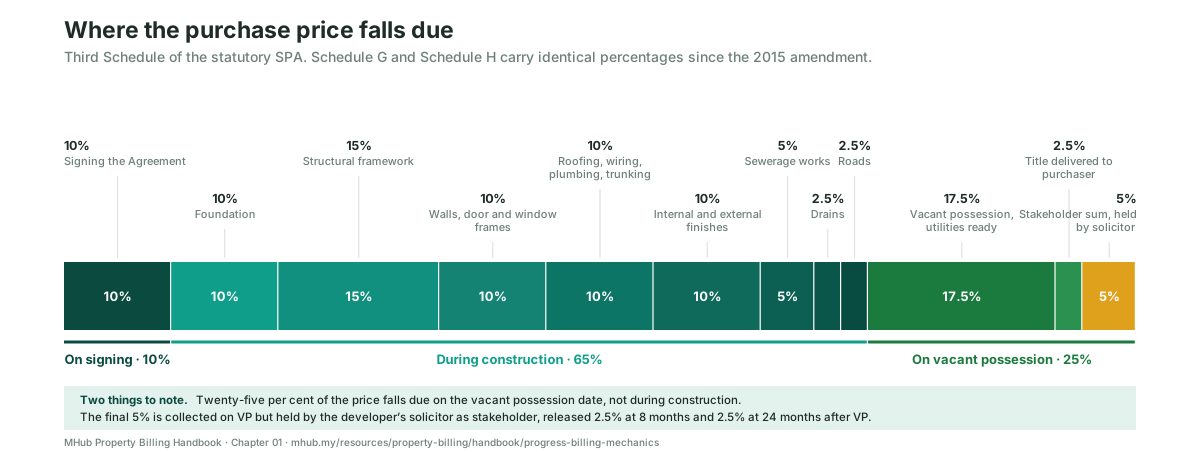
Swipe the diagram sideways to see the later stages.
| Instalment | % of purchase price |
|---|---|
| Immediately upon signing the Agreement | 10 |
| Foundation of the said Building | 10 |
| Structural framework | 15 |
| Walls with door and window frames placed in position | 10 |
| Roofing, electrical wiring, plumbing without fittings, gas piping, internal telecommunication trunking and cabling | 10 |
| Internal and external finishes including wall finishes | 10 |
| Sewerage works serving the Building | 5 |
| Drains serving the Building | 2.5 |
| Roads serving the Building | 2.5 |
| On vacant possession, water and electricity supply ready for connection | 17.5 |
| On vacant possession, where title has been delivered to the purchaser | 2.5 |
| On vacant possession, held by the developer's solicitor as stakeholder | 5 |
| Total | 100 |
Swipe the table sideways if the percentages are cut off.
Three observations worth carrying around.
Sixty-five per cent of the price is billed during construction. Ten per cent comes at signing, and the remaining twenty-five per cent all falls due on the vacant possession date. VP is not the end of billing. It is the single largest billing event in the schedule.
The final 5% is collected but not yours. It goes to the developer's solicitor as stakeholder, released 2.5% at eight months after VP and 2.5% at twenty-four months, and only if outstanding defect notices have been certified as made good. Treating it as available cash is a forecasting error, not an accounting one.
Item 4 is conditional on title, not on VP alone. The 2.5% falls due on vacant possession where the developer has actually delivered the title. Under Schedule G that is the original issue document of title registered in the purchaser's name. Under Schedule H it is the instrument of transfer together with the original strata title. If title has not been delivered, that instalment is not billable yet.
Where Schedules I and J differ
Schedules I and J govern Build Then Sell schemes on the 10:90 model. Ten per cent is paid on signing, and the remaining ninety per cent falls due within thirty days after delivery of vacant possession, supported by the Certificate of Completion and Compliance.
There is no progress billing in a BTS scheme. If your project runs on Schedule I or J, most of this page does not apply to you, and your cash flow profile is a completely different shape.
Who you bill, and in what order
This is the part most generic accounting systems get wrong, because they assume one invoice goes to one customer.
Cash purchaser. Straightforward. Bill the purchaser, collect within the period, issue an e-Receipt on payment. One party throughout.
Loan purchaser. The routing changes after the first construction instalment, and it changes because of the differential sum.
The differential sum is the purchase price less the approved loan amount, after deducting deposits already paid. The purchaser has to settle it before the financier releases anything. The sequence runs like this.
- Purchaser settles the differential sum.
- Developer issues a confirmation of differential sum settlement letter to the end financier's solicitor.
- The solicitor advises the end financier to draw down, with the progress billing attached.
- Every subsequent progress billing goes directly to the end financier, supported by an architect's certificate.
- Funds are released into the developer's Housing Development Account.
Two failure modes come out of this repeatedly.
Billing the financier before the differential sum has cleared. Without the confirmation letter the solicitor cannot advise drawdown, so the billing simply sits and ages while everyone assumes someone else is chasing it.
Billing all parties on every stage as a blanket rule. The prescribed flow is sequential and conditional. Copying the SPA solicitor, the loan solicitor, the financier and the stakeholder solicitor on every stage creates reconciliation noise and duplicate follow-up, and it obscures who is actually responsible for paying.
When payment is actually due
The prescribed SPA gives the purchaser 30 days.
The detail that matters: those 30 days run from the purchaser's receipt of the developer's written notice of completion, not from the date printed on your invoice.
In practice this means three things.
- You need to be able to evidence when the notice was served. Registered post exists for exactly this reason.
- Your due date calculation has to include however your SPA deems service to have occurred. Check the notice clause in your executed agreement, because this is the single most common place a due date is computed wrongly.
- A due date built from the invoice generation date will always be earlier than the true due date. That means reminders go out early, and late payment charges computed from that date are open to challenge.
Late payment charges under the prescribed SPA run at 10% per annum, calculated from day to day, from the expiry of the 30 day period.
The clause that costs money
The prescribed SPA also states that the developer is not entitled to impose late payment charges where the progress claim notice is incomplete or does not comply with the certification requirement.
Read that again in commercial terms. A billing issued without a valid architect's certificate does not just create rework later. It forfeits the interest income on that instalment entirely. This is the strongest argument for tight certificate control, and it is not an argument about tidiness.
When payment does not arrive
The standard credit control sequence in the prescribed SPA is short and it is fixed.
- Payment not received within the prescribed period.
- First reminder issued.
- Final notice issued if payment is still not received after 14 days.
- A further 14 days granted to settle.
- Notice of termination, in accordance with the SPA and applicable regulations.
On termination the developer may resell the property, apply the purchaser's prior payments to any outstanding late payment charges, forfeit the sum stipulated in the SPA, and refund the balance. Neither party then has any further claim under the agreement.
One caution on forfeiture. Industry guidance and the gazetted Schedule do not read identically on whether the forfeiture rate is a flat percentage or tiered against how much the purchaser has already paid. Do not quote a rate from memory or from a training deck. Read the forfeiture clause in the executed SPA for that project before you compute anything.
Where the money actually lands
Progress payments do not go into the developer's operating account.
Purchaser payments and end financier disbursements are channelled into the project's Housing Development Account, a statutory account opened with a licensed bank under the Housing Development Account Regulations 1991. One account per project.
Withdrawals from that account are restricted to the purposes stipulated in the regulations, and every withdrawal must be supported by a certificate from the architect.
The practical consequence for a credit admin team is worth stating plainly. Collection speed determines when cash enters the account. Certification and Controller approval determine when it can leave. Those are two different problems, and only the first one is yours.
The e-Invoice layer
Every progress billing is now an e-Invoice. Three rules bite in daily practice.
No UUID, not compliant. An invoice that has not been validated by LHDN's MyInvois system and returned a UUID is not a compliant document, whatever your own system shows.
Individual invoices above RM10,000. Consolidated e-Invoices no longer cover transactions above RM10,000. Every progress billing is above that threshold, so every one needs its own validated e-Invoice.
72 hours to cancel. From validation you have 72 hours to cancel or reject. After that the invoice is permanent and can only be corrected by a credit note, debit note or refund note linked to the original by UUID.
LHDN has revised implementation phases and exemption thresholds more than once. Confirm current thresholds on the MyInvois portal before relying on them for anything commercial. The 72 hour window and the RM10,000 rule are the two that affect the day job.
What this affects downstream
Progress billing does not sit on its own. Getting it wrong shows up in four other places.
Loan drawdown. No valid certificate attached means the financier's solicitor has nothing to advise drawdown against. The stage is certified, the work is done, and the money is not requested.
HDA withdrawals. Every withdrawal needs architect certification. Weak certificate records at the billing stage become weak withdrawal support later.
Reversals. A billing raised against the wrong stage or the wrong unit becomes a credit note, a re-billing, and a brand new 30 day payment clock. The reversal is visible. The lost 30 days usually is not.
Vacant possession. All prior instalments must be settled before VP can be delivered. An unresolved billing from stage four will hold up the 17.5% instalment eighteen months later.
Last reviewed August 2026. Statutory references are to the Housing Development (Control and Licensing) Act 1966, the Housing Development (Control and Licensing) Regulations 1989 and the schedules prescribed under them. This page is a working reference for developer credit administration teams. It is not legal advice, and the executed Sale and Purchase Agreement for your project governs.
Written and maintained by MHub, which builds sales and credit administration software for Malaysian property developers.
Frequently asked
No. The prescribed SPA requires every progress claim notice to be supported by a certificate signed by the developer's architect or engineer in charge. A notice without it does not comply, and the developer cannot impose late payment charges on that instalment.
No. It is 30 days from the purchaser's receipt of the written notice of completion. The service date, not the invoice generation date, is what the clock runs from.
Not since the 2015 amendment. The percentages and the stages are identical. What differs between them is title, security and the vacant possession period, not the payment schedule.
The purchaser settles the differential sum first. After the developer issues the confirmation of settlement letter to the financier's solicitor, subsequent progress billings go directly to the end financier, supported by an architect's certificate.
The final instalment of the purchase price, paid on vacant possession but held by the developer's solicitor rather than the developer. It is released 2.5% at eight months after VP and 2.5% at twenty-four months, subject to outstanding defects being certified as made good.
No. Under the 10:90 model in Schedules I and J, 10% is paid on signing and the remaining 90% falls due within thirty days after delivery of vacant possession, supported by the CCC. There are no construction stage billings.
Take the working sheets
Three printable A4 sheets covering the process on this page. No account needed.
- Architect certificate to invoice The seven checks before you raise a billing
- Multi-party billing matrix Every Third Schedule instalment, and who gets billed under cash and loan
- Month-end collections close Fourteen steps in sequence, with the escalation ladder
Or open any single sheet above. No form, no email required.
Take this further
-
All six chapters
Back to the handbook, and the rest of the billing lifecycle from booking to vacant possession.
Open the handbook -
Reversals and corrections
What to do when a billing has already gone out. Chapter 02, 12 minutes.
Next chapter
Certificate to invoice, without the rework
MHub Credit Control raises progress billings straight from the architect certificate and the booking record. It runs collections for 8 in 10 new property launches in Malaysia.