How rebates work
under e-Invoice
Why a rebate is not a discount, how it moves through the e-Invoice chain, and the offset step that has to happen before approval.
- August 2026
- last reviewed
- 11 min
- read
- Free
- no login, no email
The short answer
A rebate does not change the purchase price in the SPA. It reduces what is collected against a billing that already exists. Under e-Invoice it is issued as a credit note carrying the original billing's LHDN UUID, and it must be offset against that original progress billing before the rebate can be approved.
Rebates are the most common source of billing mess in Malaysian property development, and the reason is structural. The rebate is agreed by sales, the SPA is drafted by legal, the billing is raised by credit admin, and the tax document is the responsibility of finance. Four functions, one number, and no single owner.
This chapter is about what a rebate is contractually, what it becomes documentarily, and the one step in the middle that everyone skips.
What a rebate is, and what it is not
In practice, developers use one word for several different commercial arrangements. They do not behave the same way.
| Arrangement | What it is | Where it lands |
|---|---|---|
| Price reduction | The agreed purchase price itself is lower | Written into the SPA before signing. Every Third Schedule instalment is smaller because the base is smaller. Not a rebate at all. |
| Cash rebate | A stated sum returned to or credited against the purchaser | The purchase price is unchanged. The rebate is applied against billings raised under that price. |
| Early bird or campaign rebate | A time-limited incentive to book | Same as a cash rebate. It affects collection, not the SPA price. |
| Package in kind | Furnishing, appliances, legal fee absorption | Not a rebate against the billing. It is a cost the developer incurs. Do not net it against a progress billing. |
| Fee absorption | Developer bears legal fees or stamp duty on the purchaser's behalf | A cost, and in some cases a payment to a third party. Treat it as its own transaction, not as a reduction of the billing. |
Swipe the table sideways to read the third column.
The distinction that matters most
If the arrangement was agreed before the SPA was executed and is reflected in the purchase price, it is a price reduction and it never touches your billing process. If it was agreed at or after execution and the SPA price stays where it is, it is a rebate and it moves through the credit note chain. Teams that treat these as the same thing end up with billings that do not reconcile to the SPA.
How a rebate moves through the e-Invoice chain
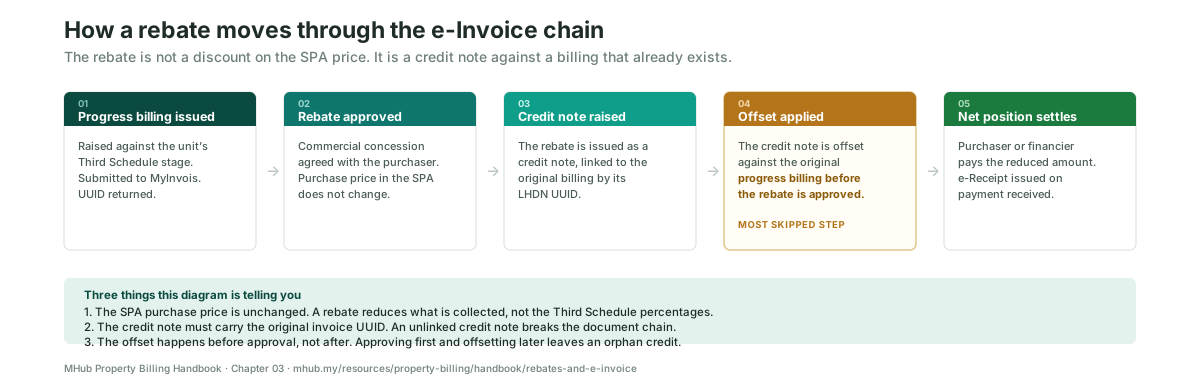
Swipe the diagram sideways to see all five steps.
Why the offset has to come first
The rebate is not a standalone credit floating against the customer account. It is a reduction of a specific billing. Offsetting it against the original progress billing before approval does three things at once.
- It proves which billing the rebate belongs to, which is what the UUID link has to evidence.
- It produces a single net receivable for that stage, so the aging report tells the truth.
- It prevents an orphan credit sitting on the account that later gets applied to an unrelated stage by someone trying to clear a balance.
Approve first and offset later, and you will spend the following month explaining why a purchaser shows a credit on stage three and an overdue on stage five.
The e-Invoice rules that apply
Three rules bite in daily rebate work.
The credit note must carry the original UUID. A credit note that is not linked to the document it corrects is not a correction, it is a second unexplained document. The UUID link is what makes the chain readable to LHDN and to an auditor.
Individual e-Invoices above RM10,000. Consolidated e-Invoices no longer cover transactions above RM10,000. Progress billings are almost always above that threshold, so each one needs its own validated e-Invoice, and each rebate credit note attaches to a specific one of them. There is no consolidated route to fall back on.
72 hours to cancel. If the rebate was known before the billing was validated, the cleaner correction may be to cancel and reissue rather than to credit. Inside 72 hours of validation that option exists. Past it, the credit note is the only route. Chapter 02 covers the gates in full.
Buyer TIN, before any of this
A validated e-Invoice needs the buyer's Tax Identification Number. If the TIN was never captured at booking, the original billing may not have been validated at all, in which case there is no UUID for the credit note to link to and the whole chain fails at the first step. Capturing TIN at booking is not a finance preference. It is what makes everything downstream possible.
Where rebates interact with the SPA and the bank
This is the part that is genuinely commercially sensitive, and it is worth stating carefully.
The purchase price stated in the SPA is the figure the bank lends against and the figure the valuer works from. A rebate does not change it. That is precisely why rebates need to be documented as what they are, applied against billings, and visible in the transaction record.
Three practical consequences.
Third Schedule percentages are computed on the SPA price. A 10% stage on a RM650,000 unit is RM65,000, whether or not a rebate has been agreed. The rebate is applied after, not built into the stage calculation.
The differential sum is affected, the loan is not. The purchaser still owes the SPA price. Where a rebate reduces what the purchaser has to find in cash, that is a differential sum conversation with the developer, not a re-pricing of the loan.
Disclosure is not optional. Arrangements that affect the effective price are relevant to the financier and the valuer. Whatever your commercial policy, the accounting record should reflect what actually happened rather than obscure it.
Where this stops being a billing question
Rebate structures that materially change the effective purchase price without being visible to the financier raise regulatory and lending issues well beyond credit administration. If you are being asked to book something that does not reconcile to the SPA, that is a question for your finance director and your legal team before it is a question for your billing system.
Practical controls worth having
- A fixed rebate reason list. Campaign, loyalty, negotiated, goodwill, correction. Five codes beat free text, because five codes can be counted and reported.
- An approval threshold. Below a stated value, credit admin can process. Above it, the finance manager approves. Write the threshold down.
- Rebate visible on the unit record, not only in the ledger. Sales, credit admin and finance should all see the same number against the same unit.
- A monthly rebate report by project. Total rebates as a percentage of billings by project tells you whether a campaign was priced or improvised.
What this affects downstream
Aging accuracy. An unoffset rebate makes a unit look overdue when it is not, or current when it is not. Either way the collections list is wrong.
Drawdown. Where the end financier was billed, the financier holds the gross figure. A rebate applied without reissuing to the financier means the bank disburses against a number that no longer matches your ledger.
VP clearance. All sums due must be settled before vacant possession can be delivered. An unresolved rebate credit from stage three surfaces as a blocker eighteen months later, at the worst possible moment.
Revenue recognition. Rebates affect the net consideration for the unit. Finance needs them booked in the right period, not swept up at year end.
Last reviewed August 2026. e-Invoice references are to the LHDN MyInvois system, where thresholds and implementation phases have been revised more than once. Confirm current rules on the MyInvois portal before relying on them commercially. This page is a working reference for developer credit administration teams. It is not legal or tax advice, and the executed Sale and Purchase Agreement for your project governs.
Written and maintained by MHub, which builds sales and credit administration software for Malaysian property developers.
Frequently asked
No. The SPA price stands, and every Third Schedule instalment is computed on it. A rebate reduces what is collected against billings raised under that price. If the price itself is lower, it is a price reduction written into the SPA, not a rebate.
As a credit note carrying the LHDN UUID of the original progress billing, offset against that billing before the rebate is approved.
Because it ties the credit to a specific billing. Approve first and you create an orphan credit that later gets applied to an unrelated stage, and the aging report stops reflecting reality.
In practice, no. Progress billings are above the RM10,000 threshold for individual validated e-Invoices, so both the billing and the credit note that corrects it are individual documents.
No. It is a cost the developer incurs, not a reduction of a billing. Netting it against a progress billing distorts both the receivable and the cost record.
Then the original billing may never have been validated, so there is no UUID for the credit note to link to. Fix the TIN at booking, not at rebate time.
Take the working sheet
One printable A4 page. No account needed.
Download the sheetNo form, no email required.
Take this further
-
Chapter 02 · Reversals and corrections
The gates, the six documents, and the order they have to happen in.
Previous chapter -
All six chapters
Back to the handbook, and the rest of the billing lifecycle from booking to vacant possession.
Open the handbook
Rebates that reconcile to the SPA
MHub Credit Control raises the rebate as a linked credit note and offsets it against the original billing before approval, so the aging report stays true.