How the loan and financier
workflow actually runs
From letter of offer to first drawdown. The differential sum, the letter of undertaking, redemption, perfection of transfer and charge, and where deals actually stall.
- August 2026
- last reviewed
- 15 min
- read
- Free
- no login, no email
The short answer
An approved loan is not funded money. Five things have to happen first: the purchaser accepts the letter of offer, the developer issues a letter of undertaking and the purchaser settles the differential sum, the security documents are executed, the bridging charge is redeemed and the transfer and charge are perfected at the Land Office, and only then does the bank disburse into the developer's Housing Development Account.
Credit admin usually meets this process at the point where a billing has been sent and nothing has come back. The useful thing is to know which of the five stages the unit is actually sitting in, because the fix is different in each one and only two of them are anything to do with billing.
The five stages
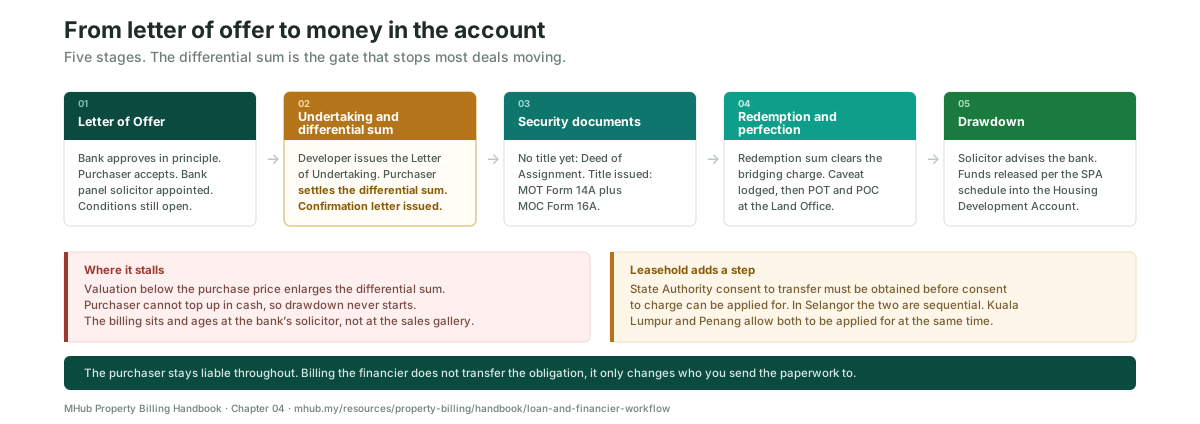
Swipe the diagram sideways to see all five stages.
Stage 1. Letter of offer
The bank approves in principle and issues a letter of offer. The purchaser accepts it, and the bank's panel solicitor is appointed to handle the loan documentation.
Approval at this stage is conditional. Employment, valuation and credit history conditions remain open, which is why a unit can sit at stage one for weeks and then fall over entirely.
What credit admin does here: record the financier, the loan amount and the solicitor. The loan amount is what tells you whether a differential sum exists and how large it is.
Stage 2. Undertaking and differential sum
This is where most units get stuck, and it is worth slowing down on.
The letter of undertaking. The bank's solicitor requests an undertaking from the developer before releasing funds. The developer replies with a letter of undertaking, which is a binding assurance covering matters such as delivering clean title on full settlement and refunding the financier if the transfer, the charge or the project itself fails.
The differential sum. This is the purchase price less the approved loan amount, after deducting deposits already paid. The purchaser has to settle it in cash. The developer notifies the purchaser of the amount, the purchaser pays, and the developer then issues a confirmation of differential sum settlement to the financier's solicitor.
Why the differential sum is the real gate
Until the developer issues that confirmation letter, the financier's solicitor cannot advise the bank to draw down. Every progress billing you send to the financier before that point will sit and age, and no amount of chasing the bank will move it, because the bank is not the party holding it up.
Where the valuation comes in below the purchase price, the loan is smaller and the differential sum grows. Many purchasers cannot or will not top up. The unit is then committed but effectively dead, and it will read on your aging report as a slow payer rather than a failed sale.
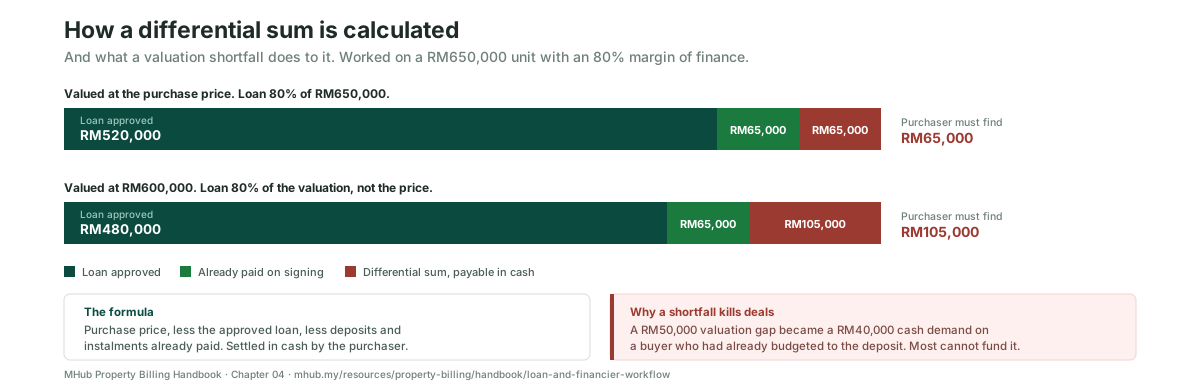
Swipe the diagram sideways to see both scenarios.
Stage 3. Security documents
What the bank takes as security depends on whether a separate title has been issued for the unit.
| Title position | Security instrument | What else happens |
|---|---|---|
| No separate title issued yet. Typical for strata under construction. | Deed of Assignment over the purchaser's rights under the SPA | The developer acknowledges the notice of assignment. The bank holds the buyer's contractual rights, not a registered interest in land. |
| Title already issued. Typical for landed with individual title. | Memorandum of Transfer, Form 14A, plus a Charge, Form 16A | Form 14A is executed with the developer, Form 16A with the bank. These are registrable instruments and go on to perfection. |
Swipe the table sideways to read the third column.
What credit admin does here: nothing directly, but this is the stage that determines how long stage four will take. A unit with title already issued has a longer conveyancing path ahead of it, not a shorter one.
Stage 4. Redemption and perfection
Two separate things happen and they are often confused.
Redemption. The land the project sits on is usually charged to a bridging financier. Before clean title can pass to the purchaser, that charge has to be discharged for the relevant unit. The redemption sum is the amount required to do it, and it can be a substantial proportion of the unit price. Funds are released to settle it, the master chargee discharges, and the title is released.
Perfection. The solicitor lodges a private caveat to protect the purchaser's interest, then completes the Perfection of Transfer and the Perfection of Charge at the Land Office. These register the purchaser as proprietor and the bank as chargee.
Leasehold adds a step, and in Selangor it is sequential
On leasehold land, State Authority consent to transfer must be obtained before consent to charge can be applied for. In Selangor the two applications run one after the other, which is why developers apply for blanket consent to transfer as soon as the SPA is stamped. Kuala Lumpur and Penang allow both consents to be applied for at the same time.
If you are forecasting collection dates on a leasehold project in Selangor and using freehold timelines, your forecast is wrong.
Stage 5. Drawdown
The solicitor confirms stamping and advises the bank. The bank then releases funds progressively, in line with the SPA payment schedule, against progress billings supported by an architect's certificate.
The money goes into the developer's Housing Development Account, not to the developer directly. Withdrawals from that account are separately restricted and separately certified. Chapter 01 covers this.
Who you bill, and when it changes
The billing recipient changes partway through, and the trigger is the differential sum.
Before settlement: the purchaser is billed. The first construction instalment usually lands here.
At settlement: the developer issues the confirmation of differential sum settlement to the financier's solicitor, who advises the bank to draw down with the progress billing attached.
After settlement: every subsequent progress billing goes directly to the end financier, supported by an architect's certificate.
Two things stay true throughout. The purchaser remains liable under the SPA regardless of who receives the paperwork, and every billing after the first must carry certification.
Where deals actually stall, in order of frequency
| Symptom | What is really happening |
|---|---|
| Billing sent, nothing received | The differential sum has not been settled, so the solicitor cannot advise drawdown. Chase the purchaser, not the bank. |
| Bank silent for weeks | The undertaking has been requested and the developer has not issued the letter of undertaking. This is internal, not external. |
| Purchaser stopped responding | Valuation shortfall enlarged the differential sum beyond what they can fund. This becomes a termination conversation, not a collections one. |
| Everything approved, no disbursement | Redemption or perfection is outstanding. On leasehold, likely waiting on State consent. |
| Financier queries the billing | The architect's certificate was not attached, or the stage on the billing does not match the payment schedule. |
| Loan withdrawn after approval | Job loss, divorce or new debt after the letter of offer. The bank re-tests conditions and pulls approval. |
Swipe the table sideways if the second column is cut off.
What credit admin should be tracking
Six fields per unit. If these are in a spreadsheet, they are already out of date.
- End financier and the loan amount approved
- Financier's solicitor and the file reference
- Differential sum: amount, notified date, settled date
- Letter of undertaking: requested date, issued date
- Stage the unit is sitting in, out of the five
- Last drawdown received, and against which billing stage
Aging by banker and by lawyer, rather than only by customer, is what turns those fields into something actionable. Ten units stuck behind the same solicitor is one phone call. Ten units stuck behind ten different purchasers is ten conversations.
What this affects downstream
Cash forecasting. A unit at stage two and a unit at stage five look identical on a standard aging report and are months apart in reality.
Vacant possession. All sums must be settled before VP can be delivered. A loan that never perfected becomes a VP blocker at the end of the project.
Termination exposure. Where a purchaser cannot obtain financing on stated grounds, the prescribed SPA provides a specific termination route with its own forfeiture treatment. Read the clause in the executed SPA rather than applying the general default provisions.
HDA position. Drawdowns land in the Housing Development Account. Collection speed determines when cash enters. Certification and approval determine when it can leave.
Last reviewed August 2026. Statutory references are to the Housing Development (Control and Licensing) Act 1966, the National Land Code and the schedules prescribed under them. Consent procedures vary by state and the position described for Selangor, Kuala Lumpur and Penang should be confirmed locally. This page is a working reference for developer credit administration teams. It is not legal advice, and the executed Sale and Purchase Agreement for your project governs.
Written and maintained by MHub, which builds sales and credit administration software for Malaysian property developers.
Frequently asked
The purchase price less the approved loan amount, after deducting deposits already paid. The purchaser settles it in cash, and the developer then confirms settlement to the financier's solicitor so drawdown can be advised.
Most often because the differential sum has not been settled and the confirmation letter has not gone to the financier's solicitor. Approval and funding are separate events.
A binding assurance from the developer to the end financier, covering matters such as delivering clean title on full settlement and refunding the financier if the transfer, charge or project fails. The bank's solicitor requests it before funds are released.
Where no separate title has been issued for the unit, which is typical for strata under construction. The bank takes the purchaser's rights under the SPA. Once title exists, the security is a Memorandum of Transfer plus a Charge.
The amount required to discharge the bridging financier's charge over the land so that clean title can pass to the purchaser. It is settled from the loan release before the transfer can be perfected.
Yes. State Authority consent to transfer must be obtained before consent to charge can be applied for. In Selangor these run sequentially. Kuala Lumpur and Penang allow both to be applied for at the same time.
The end financier directly, supported by an architect's certificate, with the purchaser copied. The purchaser remains liable under the SPA regardless of who receives the billing.
Take the working sheet
One printable A4 page. No account needed.
Download the sheetNo form, no email required.
Take this further
-
Chapter 03 · Rebates and e-Invoice
Why a rebate is not a discount, and the offset step that comes before approval.
Previous chapter -
Chapter 05 · SST and tax treatment
Which taxes touch a property development billing, and which do not.
Next chapter -
Chapter 01 · Progress billing mechanics
The Third Schedule stages, and the Housing Development Account the drawdown lands in.
Read chapter 01
Know which stage every unit is sitting in
MHub Credit Control tracks financier, solicitor, differential sum and drawdown per unit, so aging can be read by banker and by lawyer, not only by customer.