Vacant possession billing,
start to finish
What must be true before VP can be delivered, the 25% of the purchase price that falls due on that date, deemed possession, and the stakeholder sum releases at 8 and 24 months.
- August 2026
- last reviewed
- 11 min
- read
- Free
- no login, no email
The short answer
Vacant possession is the largest billing event in the whole schedule. Twenty-five per cent of the purchase price falls due on that one date: 17.5% on delivery with utilities ready, 2.5% where title has been delivered, and 5% collected but paid straight to the developer's solicitor as stakeholder. The same date starts the defects liability period and both stakeholder release clocks.
Most teams treat VP as the end of billing. It is not. It is the largest single collection of the project, and it is also the moment four statutory clocks start running, three of which run whether or not the purchaser ever collects the keys.
One notice, four clocks
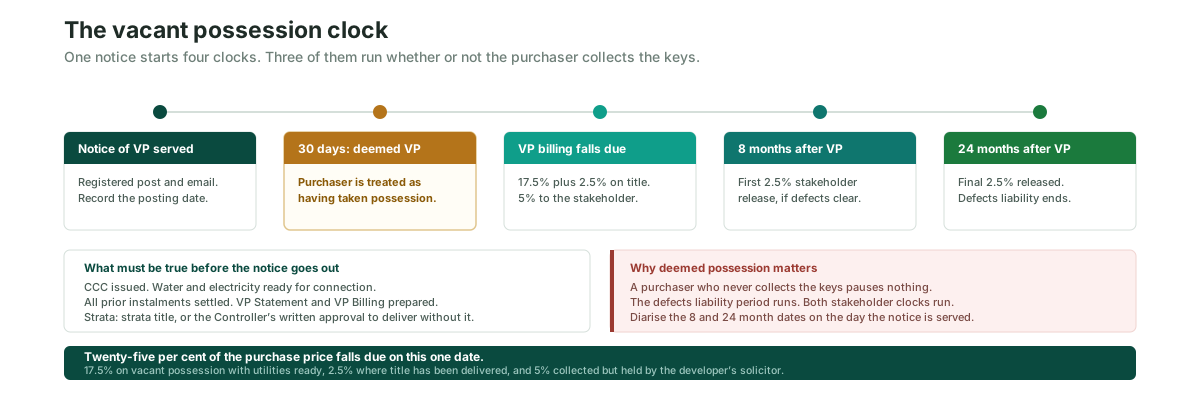
Swipe the diagram sideways to see all four clocks.
What has to be true before the notice goes out
The prescribed SPA sets the conditions for delivery. Missing any one of them means the developer cannot legally deliver, and a notice served prematurely is worse than a notice served late.
- The Certificate of Completion and Compliance has been issued.
- Water and electricity supply are ready for connection to the unit.
- The purchaser has paid all monies payable under the Third Schedule and all other sums due under the SPA.
- Any agreed alteration or additional work is complete.
- Strata only. The strata title has issued, or the Housing Controller has given written approval to deliver vacant possession without it.
Financial clearance is one of five conditions, not the condition
Credit admin naturally focuses on the outstanding balance, because that is the part it owns. The strata title position and the Controller's approval have nothing to do with the purchaser's account balance, and they will stop delivery just as firmly.
Strata developments have one more obligation
Before delivering vacant possession, the developer must deposit a sum with the Commissioner of Buildings to cover the rectification of common property defects. It is payable in cash or by bank guarantee, at not less than 0.5% of the estimated construction cost excluding land, or RM50,000, whichever is higher.
Notice of the intention to deliver vacant possession goes to the Commissioner 21 days beforehand, supported by a certificate of estimated construction cost from the developer's architect or engineer. Failure to pay is an offence.
The unexpended balance is refunded on expiry of the common property defects liability period, or on completion of rectification works to the Commissioner's satisfaction, whichever is later.
The money that falls due on the VP date
| Instalment | What triggers it | Where it goes |
|---|---|---|
| 17.5% | Vacant possession delivered with water and electricity ready for connection | The developer, through the Housing Development Account. The single largest instalment in the Third Schedule. |
| 2.5% | Vacant possession, where the developer has delivered title | The developer. Schedule G: the original issue document of title registered in the purchaser's name. Schedule H: the instrument of transfer plus the original strata title. If title has not been delivered, this instalment is not yet billable. |
| 5% | Vacant possession | The developer's solicitor, as stakeholder. It is collected but it is not developer cash and it does not enter the operating account. |
| 25% | Of the purchase price, falling due on one date | |
Swipe the table sideways to read the third column.
The other charges on the VP Statement
Separate from the Third Schedule instalments, the purchaser settles a set of outgoings and deposits at handover. These usually sit on a VP Statement rather than the progress billing.
- Quit rent and assessment, prorated. Under the prescribed SPA these run from the date the purchaser takes vacant possession or the date of transfer, whichever is earlier.
- Water and electricity deposits for each parcel.
- Maintenance charges and sinking fund on strata developments, commonly billed as four months' contribution in advance.
- Insurance and other prescribed charges where applicable.
Who produces what
VP stalls when one department assumes another has the document. The Project Manager owns the CCC and the utility deposit receipts. The Property Manager owns the maintenance and sinking fund invoices on strata. Sales and Credit Admin owns the Notice of VP, the VP Statement and the VP Billing. Any missing item and the notice cannot be served, which means the deemed possession clock never starts.
Deemed vacant possession
This is the clause that surprises people and it is the most useful thing on this page.
Thirty days after the developer serves notice requesting the purchaser to take delivery of vacant possession, the purchaser is deemed to have taken possession, whether or not they actually collected the keys.
The consequences run regardless.
- The 24 month defects liability period starts.
- The 8 month and 24 month stakeholder release clocks start.
- Outgoings run from that date, not from when the purchaser turns up.
A purchaser who ignores the notice pauses nothing. This is why the posting date of the notice has to be recorded, and why registered post exists.
The stakeholder sum, in and out
The 5% is the most misunderstood instalment in the schedule, because it is collected on one date and released on two others.
| Event | Amount | Condition |
|---|---|---|
| On vacant possession | 5% in | Collected from the purchaser and remitted to the developer's solicitor as stakeholder. It never sits in the developer's account. |
| 8 months after VP | 2.5% out | Released to the developer, unless a defect notice served before that date remains unresolved. Release requires the developer's architect to certify the defect made good. |
| 24 months after VP | 2.5% out | Same condition. The defects liability period ends at this point. |
Swipe the table sideways to read the condition column.
Two further points that matter commercially.
The purchaser can draw against it. Where the developer fails to rectify a notified defect within the period allowed, the purchaser may rectify and recover the cost from the stakeholder sum, subject to notifying the developer of the intent and the cost first.
It is not a single release after the DLP. Treating the 5% as one lump payable at 24 months understates cash at month eight and overstates it at month twenty-four.
Three pots of money held after handover
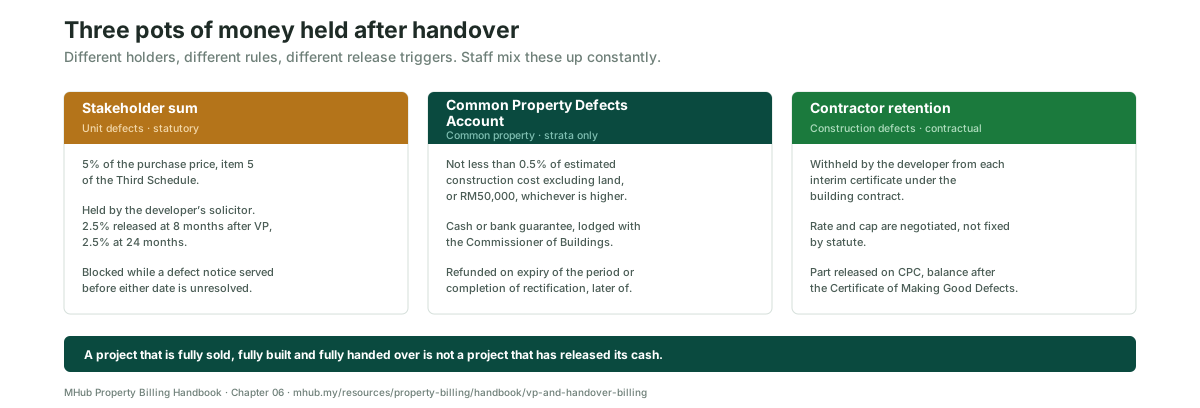
Swipe the diagram sideways to see all three.
After VP, what credit admin still owns
- Diarise the 8 and 24 month dates on the day the notice is served, per unit, not per project. Different units take VP on different dates.
- Track outstanding defect notices against stakeholder releases. One open notice blocks a release for that unit.
- Strata: track the common property defects deposit and its refund trigger.
- Housing Development Account surplus. After the CCC, the developer applies to the Controller to withdraw the surplus. After the defects liability period expires and the solicitor certifies that titles have transferred for every SPA, the developer applies to withdraw the remaining monies and close the account.
The forecasting point worth taking to your finance director
Cash stays locked well past handover. The 5% sits with a solicitor for two years in two tranches. On strata, the common property defects deposit sits with the Commissioner until the defects period closes or rectification is accepted. And the Housing Development Account itself cannot be fully drawn until titles have transferred across the whole project. A project that is fully sold, fully built and fully handed over is not a project that has released its cash.
What this affects downstream
Any unresolved billing from earlier stages becomes a VP blocker. All sums due must be settled before delivery. A credit note from stage four that was never cleared surfaces here, eighteen months later.
The defects liability period is a credit control period too. Stakeholder releases are money, and they are conditional on defect closure. Defect management and collections stop being separate functions.
Management transition follows. On strata, the developer's management period and the timetable to convene the first Joint Management Body annual general meeting both run from the first VP date.
Last reviewed August 2026. Statutory references are to the Housing Development (Control and Licensing) Act 1966, the schedules prescribed under it, and the Strata Management Act 2013. This page is a working reference for developer credit administration teams. It is not legal advice, and the executed Sale and Purchase Agreement for your project governs.
Written and maintained by MHub, which builds sales and credit administration software for Malaysian property developers.
Frequently asked
Twenty-five per cent. 17.5% on delivery with utilities ready, 2.5% where title has been delivered, and 5% collected but held by the developer's solicitor as stakeholder.
Thirty days after the developer serves notice requesting the purchaser to take delivery, the purchaser is treated as having taken possession whether or not they collected the keys. The defects liability period and both stakeholder clocks start from that point.
Only with the Housing Controller's written approval. Otherwise the strata title is a precondition of delivery on a strata development.
In two tranches. 2.5% at eight months after vacant possession and 2.5% at twenty-four months, in each case subject to any defect notice served beforehand being certified by the architect as made good.
Under the prescribed SPA, outgoings run from the date the purchaser takes vacant possession or the date of transfer, whichever is earlier.
A deposit lodged with the Commissioner of Buildings before delivery of vacant possession on a strata development, in cash or by bank guarantee, at not less than 0.5% of the estimated construction cost excluding land, or RM50,000, whichever is higher. It is refunded when the common property defects period ends or rectification is accepted, whichever is later.
Not entirely. A defect that recurs after the period can go back to the developer as unfinished work, and on strata the common property deposit is only refunded once the Commissioner is satisfied. Treat 24 months as the end of the standard rectification obligation, not the end of exposure.
Take the working sheet
One printable A4 page. No account needed.
Download the sheetNo form, no email required.
Take this further
-
Chapter 05 · SST and tax treatment
Which taxes touch a property development billing, and which do not.
Previous chapter -
All six chapters
Back to the handbook. Every chapter is written, from progress billing mechanics through to this one.
Open the handbook -
Chapter 01 · Progress billing mechanics
The Third Schedule stages that lead up to this one, and the Housing Development Account.
Read chapter 01
VP without the eighteen-month surprise
MHub Credit Control tracks the VP date per unit, diarises both stakeholder releases, and blocks a release while a defect notice is still open.