SST and tax treatment on
property development billing
Why progress billings carry no service tax, where the 6% construction services tax actually lands, and the stamp duty the purchaser pays.
- August 2026
- last reviewed
- Quarterly
- review cycle
- 12 min
- read
- Free
- no login, no email
The short answer
The sale of a property is not a prescribed taxable service, so progress billings to purchasers do not carry service tax, whether the unit is residential or commercial. Service tax reaches a developer on the cost side instead, through the 6% charge on construction works that came into scope on 1 July 2025. Stamp duty is a separate regime and it is the purchaser's liability.
This is the page where developers most often carry an out-of-date position, because the rules genuinely changed in 2025 and then changed again in October 2025. If your billing templates or tax codes were set before mid-2025, they need reviewing.
Three separate regimes, and only one of them touches your invoice
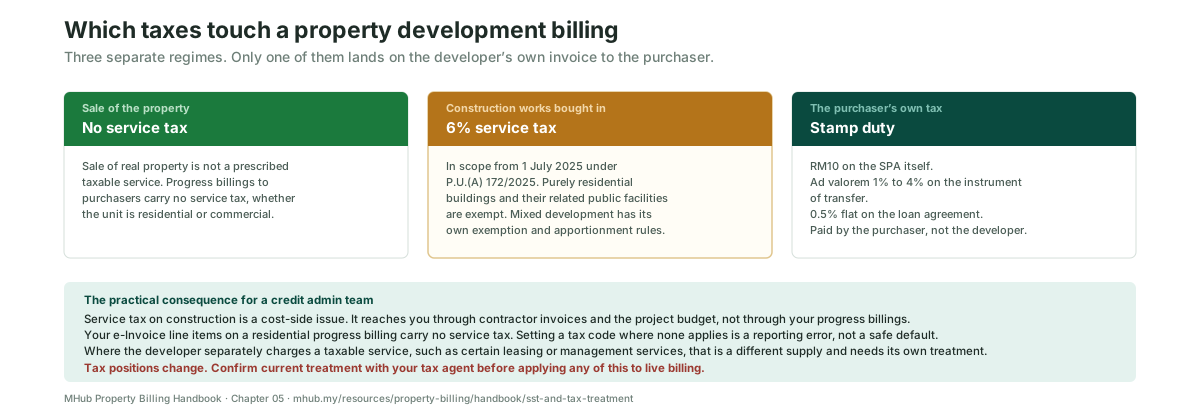
Swipe the diagram sideways to see all three regimes.
Regime 1. The sale itself carries no service tax
Service tax applies to prescribed taxable services. Sales tax applies to taxable goods. The sale of real property falls into neither category.
That means a progress billing raised against a Third Schedule stage, sent to a purchaser or to an end financier, carries no service tax. This holds whether the unit is residential or commercial.
Setting a tax code where none applies is not a safe default
Teams sometimes apply a tax code to progress billings on the reasoning that it is safer to charge and account than to miss. It is not. It overstates the purchaser's liability, it produces an SST return that does not reflect a taxable supply, and it creates a correction chain that has to be unwound with credit notes. The correct treatment on a residential progress billing is no service tax, applied deliberately rather than by omission.
Regime 2. Construction works, in scope since 1 July 2025
This is the change that caught the industry. From 1 July 2025, construction work services came within the scope of service tax at 6%, under the Service Tax (Amendment) Regulations 2025.
The scope covers construction, extension, installation, repair, renewal, removal, renovation, alteration, dismantling, demolition and facility maintenance carried out during the construction period.
What is exempt
- Purely residential buildings, and the public facilities related to those residential buildings.
- Mixed development. An exemption is available to developers and landowners undertaking the construction of residential buildings and their related public facilities within a mixed development project, subject to prescribed conditions. Where public facilities are shared between residential and non-residential buildings, apportionment is permitted.
- Business to business. Exemption facilities apply between registered service providers, to avoid tax cascading through a contracting chain.
- Government and certain bodies. Services to federal and state government, local authorities and places of worship, subject to conditions.
Registration threshold
A contractor must register for service tax where total taxable construction services exceed RM1,500,000 in any 12-month period. There is meaningful nuance in what counts toward that threshold, so a contractor working out its own position should take advice rather than assume.
Materials versus works
Where a service provider issues separate invoices or itemised billing splitting construction materials from construction works, service tax is imposed only on the value of the works. Where the invoice does not separate them, tax is imposed on the total contract value.
For a developer receiving contractor invoices, that single formatting decision changes the tax on the invoice. It is worth agreeing in the contract, not discovering at the first claim.
Contracts signed before the change
A transitional exemption applies to non-reviewable contracts made in writing and signed before 1 July 2025, and duly stamped by LHDN before the prescribed date, subject to conditions. The window for this relief has been amended more than once since it was introduced, so confirm the current end date rather than working from a figure in an old briefing note.
What this means for a credit admin team, practically
It reaches you through contractor invoices and the project cost budget, not through your progress billings.
On a pure residential project, the construction works exemption should mean your contractors are not charging it. If they are, ask why.
On a mixed development, apportionment is a live calculation and it belongs with the quantity surveyor and the tax agent, not with credit admin.
It does not change the Third Schedule. Stage percentages are unaffected.
Regime 3. Stamp duty, which the purchaser pays
Stamp duty is separate from SST, it is administered by LHDN rather than Customs, and it is the purchaser's liability rather than the developer's. Credit admin needs to recognise it because it appears in the purchaser's cost of completion and in the solicitor's statements.
| Document | Duty | Notes |
|---|---|---|
| The SPA itself | RM10 | Fixed duty per set. The agreement does not attract ad valorem duty. |
| Instrument of transfer. Memorandum of Transfer, Form 14A. | 1% to 4% | 1% on the first RM100,000. 2% on the next RM400,000. 3% on the next RM500,000. 4% above RM1,000,000. This is the ad valorem duty. |
| Loan or financing agreement | 0.5% | Flat on the loan amount, also the purchaser's liability. |
Swipe the table sideways to read the notes column.
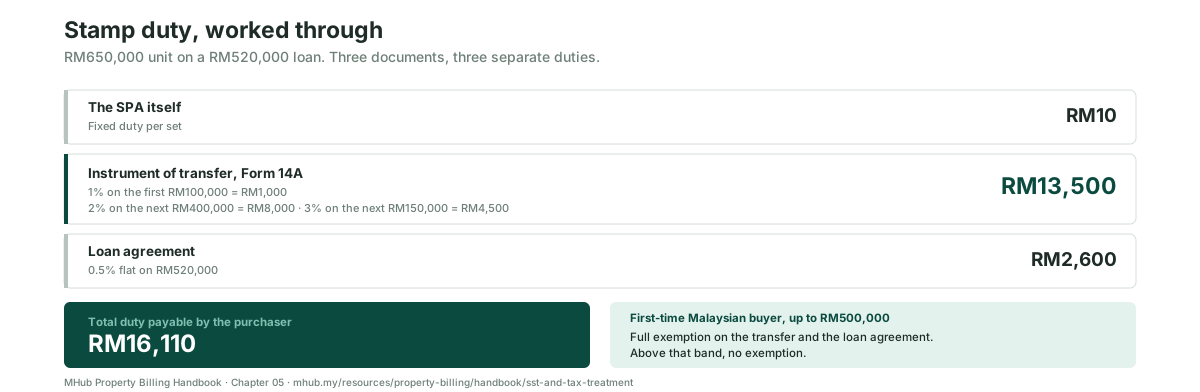
Swipe the diagram sideways to see the total.
Exemptions and recent changes
First-time Malaysian buyers purchasing a residential property valued up to RM500,000 have a full exemption on both the instrument of transfer and the loan agreement, extended under Budget 2026. Citizens only, and the exemption does not extend above the stated value band.
Non-citizens and foreign-owned companies are subject to a flat transfer duty rate introduced from January 2026, materially higher than the resident tiers.
Self-assessment. Stamp duty operates on a self-assessment basis, with duty payable within 30 days of execution of the instrument.
The most common misconception
The 1% to 4% tiers are frequently described as duty on the SPA. They are not. They sit on the instrument of transfer. The SPA itself attracts RM10. Strata units pay transfer duty too, once the strata title issues and the transfer is executed. Getting this backwards in front of a purchaser is a credibility problem that is easy to avoid.
Two things that are not taxable, and are often assumed to be
Liquidated and ascertained damages. Compensation for late delivery is treated as compensation for loss rather than consideration for a supply.
Forfeited deposits on termination. Same reasoning. It is retained compensation, not payment for a service rendered.
Both should still be recorded properly in the ledger. Not taxable is not the same as not accounted for.
What your billing system needs to handle
- Entity SST registration number configured before any SST transaction is recorded.
- Tax rates and tax types defined, with tax codes linked to the correct chart of accounts, so postings land in the right place.
- Product tariff codes created and preset against line items, so classification is consistent rather than selected by hand on every transaction.
- Receipts knocked off against invoices. On many systems only knocked-off transactions appear in the SST return, which means an unknocked receipt is an understated return.
- Tariff code editable at transaction line level for the exceptions, with the change logged.
What this affects downstream
The SST return. Wrong tax codes on progress billings produce a return that does not reconcile to a taxable supply, and correcting it means credit notes on documents that should never have carried tax.
Contractor claims and the project budget. On a non-residential or mixed development, 6% on construction works is a real cost line. If it was not in the feasibility, it is a margin problem, not an accounting one.
Purchaser conversations. Stamp duty is the purchaser's largest single completion cost after the deposit. Quoting it correctly is part of the sales conversation, and quoting it wrongly comes back to credit admin.
Read this before you apply anything on this page
Tax treatment for Malaysian construction and property moved substantially in 2025 and was amended again in October 2025. Policies, exemption facilities and transitional windows have all been revised since introduction. This page states the position as understood in August 2026 and is written to help you ask the right questions. It is not tax advice. Confirm current treatment with your tax agent, and with the Royal Malaysian Customs Department for service tax, before applying any of it to live billing.
Last reviewed August 2026. Service tax references are to the Service Tax Act 2018 and the Service Tax (Amendment) Regulations 2025, together with Service Tax Policies issued by the Royal Malaysian Customs Department. Stamp duty references are to the Stamp Act 1949 and subsequent exemption orders. This page is a working reference for developer credit administration teams. It is not tax advice. Confirm current treatment with your tax agent before applying it.
Written and maintained by MHub, which builds sales and credit administration software for Malaysian property developers.
Frequently asked
No. The sale of real property is not a prescribed taxable service, so progress billings carry no service tax, residential or commercial.
Yes, at 6%, from 1 July 2025. Purely residential buildings and their related public facilities are exempt, and specific exemption facilities apply to mixed development, business to business transactions and government works.
RM1,500,000 of total taxable construction services within any 12-month period. What counts toward the threshold carries nuance, so a contractor should confirm its own position with a tax agent.
Where the invoice separately itemises materials and works, tax applies only to the works. Where it does not separate them, tax applies to the total value. The invoicing format changes the outcome.
RM10 as a fixed duty. The ad valorem tiers of 1% to 4% sit on the instrument of transfer, not on the SPA. The loan agreement attracts a flat 0.5%.
No. It is treated as compensation for loss rather than consideration for a supply. The same reasoning applies to deposits forfeited on termination.
Yes. The construction services position changed on 1 July 2025 and policies were amended again in October 2025. Any configuration predating that should be reviewed with your tax agent.
Take this further
-
Chapter 04 · Loan and financier workflow
The five stages from letter of offer to drawdown, and where deals stall.
Previous chapter -
Chapter 03 · Rebates and e-Invoice
Why a rebate is a credit note, not a discount on the SPA price.
Read chapter 03
Tax codes that match the treatment
MHub Credit Control holds tax types, tariff codes and the SST registration against the entity, so a residential progress billing does not pick up a code it should never carry.